


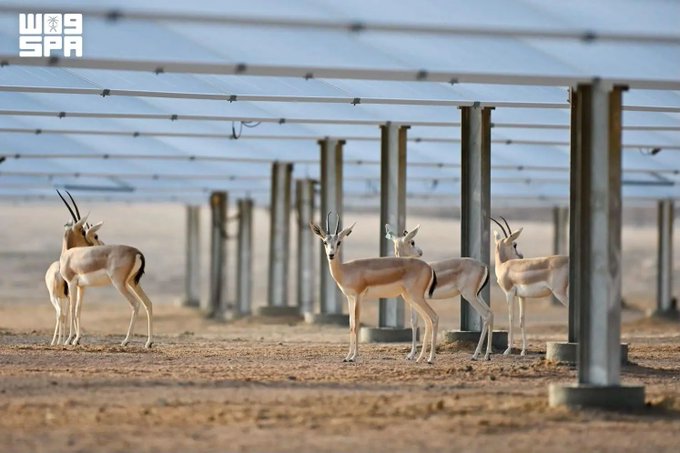
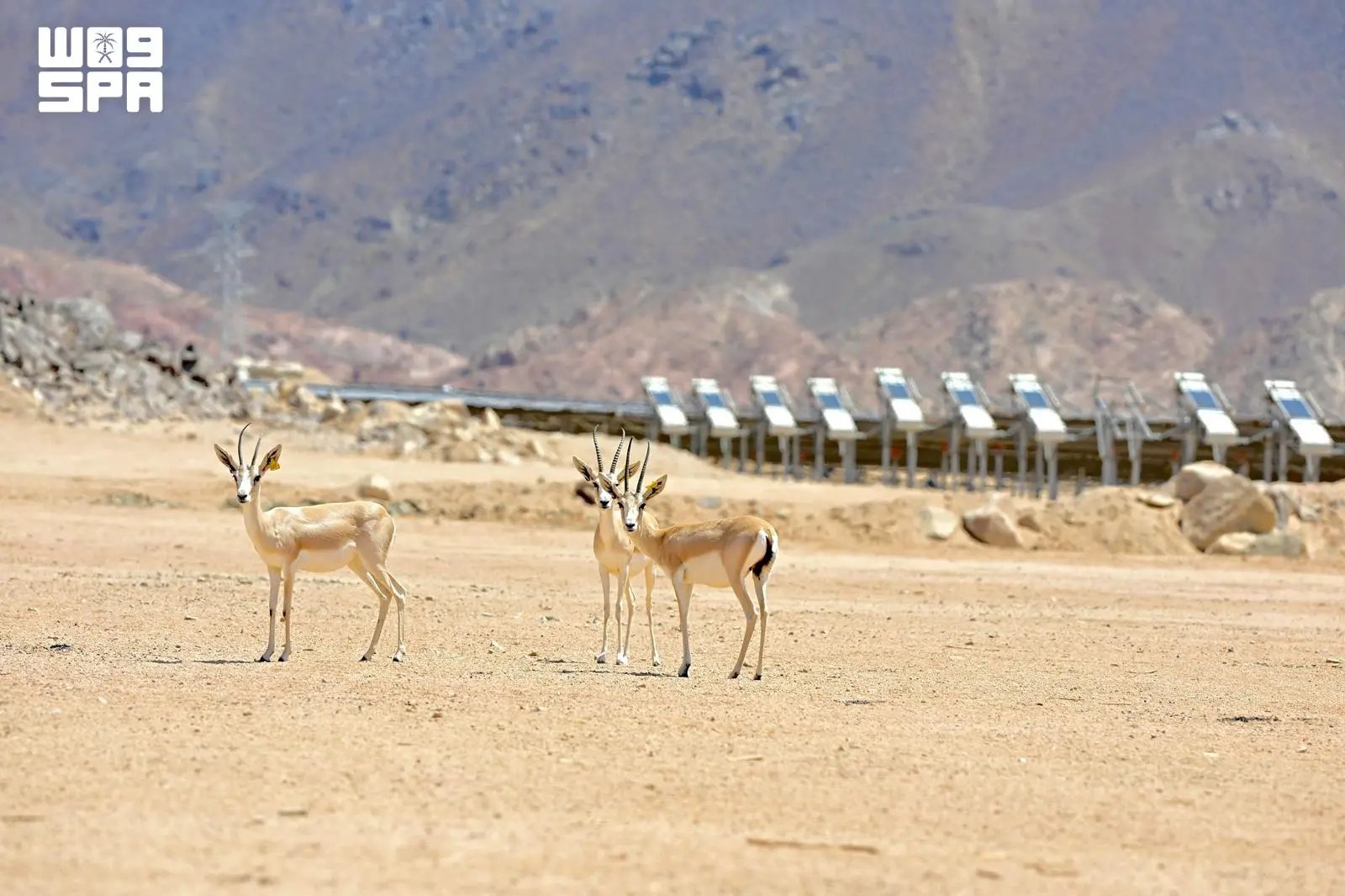
Thirty-eight sand gazelles are forming the foundation of a wildlife breeding programme inside an operating Saudi solar park. The animals will produce herds for eventual release into the Prince Mohammed bin Salman Royal Reserve, which describes the approach as a global conservation first.
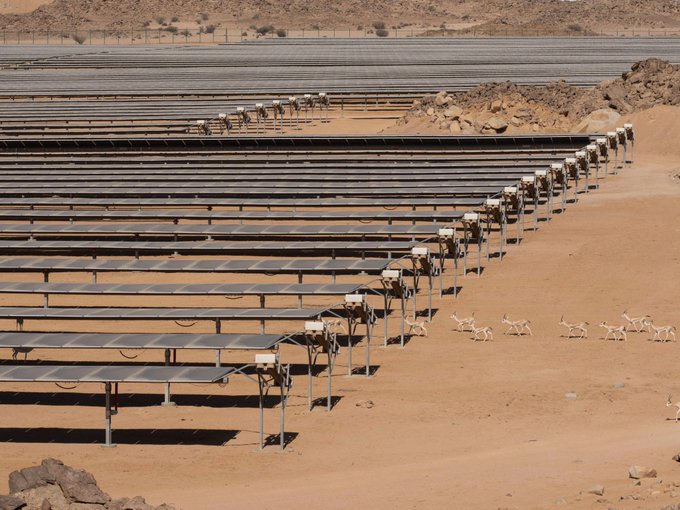
The project, known as “rewilding voltaics,” turns protected areas beneath and around solar panels into space for animal husbandry. Births are anticipated in December, while modelling suggests the population could increase to about 600 gazelles by 2031.
Electricity generation continues alongside the conservation work. The 250-megawatt facility powers Red Sea Global’s AMAALA destination and provides breeding space for animals destined for the reserve’s 24,500-square-kilometre landscape.
Covering 505 hectares, the park was built and is managed by Amaala Sustainable Company for Energy, a joint venture involving EDF Group, Masdar, SUEZ and Korea East-West Power.
Reserve CEO Andrew Zaloumis told Arab News that the programme extends efforts to combine solar power production with environmental benefits. He cited more than 15 years of international work linking solar installations with farming through agrivoltaics, ecosystem services through ecovoltaics and biodiversity protection through conservoltaics.
Zaloumis said the reserve had found no published research or information documenting the husbandry of wild animals within solar installations. It has prepared a short academic paper explaining the research and methods behind its approach.
The current breeding phase began in May with 33 females and five males. Sand gazelles are classified as vulnerable.
Before establishing the herd, the reserve conducted a seven-month trial involving sand gazelles, mountain gazelles and Arabian hares. That assessment began in October 2025 and, according to the reserve, showed that the facility could support wildlife husbandry.
Conditions within the park offer several advantages for breeding. Its perimeter is designed to exclude predators, and shade cast by the panels reduces ground temperatures by roughly 5 to 10 degrees Celsius.
Approximately 73 percent of the grounds can accommodate captive breeding. Suitable areas include sheltered space below the panels and open terrain containing natural features such as rocky outcrops.
The park’s size also allows gazelles to move as a herd and carry out natural behaviours, including courtship, mating and giving birth. Smaller enclosures at conventional breeding centres can constrain such movement.
Zaloumis said managing animals at herd level could improve breeding output and genetic health while producing animals better able to adapt. The initiative has increased the reserve’s husbandry capacity 15-fold, with specialist rangers tracking behaviour, health and reproduction.
The species was selected because of its contribution to desert ecosystems and its suitability for the facility. Gazelles can pass underneath the panels without disrupting infrastructure, while their feeding helps manage vegetation and distribute seeds.
Projections developed by the reserve’s Scientific Services Division put the potential population at around 600 by 2031, subject to effective genetic management. At least 500 founder animals would be required for successful reintroduction across the wider landscape, the reserve estimates.
Breeding management will include screening and rotating males to reduce inbreeding. Additional animals will be brought into the herd when necessary to preserve genetic diversity.
For Zaloumis, the challenge of restoring wildlife involves more than producing enough animals.
“The main barriers are scale, husbandry capacity, genetic management and habitat restoration,” he said.
Saudi Arabia has set a target of protecting 30 percent of its land and marine areas by 2030. The reserve says terrestrial conservation coverage has grown from 4.2 percent to 18.3 percent over the past decade, alongside the establishment of eight royal reserves.
Repopulating these landscapes requires large initial herds. Nationwide demand for sand gazelles alone runs into thousands of animals, putting additional pressure on existing breeding facilities.
Zaloumis said solar parks could help meet that demand by providing herd-level husbandry space within land and infrastructure already in use.
The reserve links the initiative to the Kunming-Montreal Global Biodiversity Framework, as it uses renewable energy infrastructure to breed animals for release into restored habitats.
Its contribution to national biodiversity goals will also be judged by whether the approach is adopted elsewhere. Zaloumis said replication across Saudi Arabia and the wider Arabian Peninsula would demonstrate its ability to support rewilding and expand breeding capacity.
“Successful rewilding is not just about population numbers; it is about ecosystem functionality,” he said.
Sand gazelles help sustain desert habitats through seed dispersal, vegetation regeneration and nutrient cycling, Zaloumis explained. Grazing can limit the dominance of individual plant species, while gazelles also provide prey that supports natural food chains.
He said expanding effective breeding could accelerate vegetation recovery, improve ecosystem functioning and increase species diversity across larger landscapes.
Continued monitoring of wildlife and ecosystems will help the reserve assess the programme’s results. Findings are intended to support similar initiatives where renewable energy facilities can also accommodate wildlife restoration.
Source: Arab News





.webp?w=1920&q=100)

.jpeg?w=1920&q=100)
.jpg?w=1920&q=100)

.jpg?w=1920&q=100)
.jpg?w=1920&q=100)

.jpg?w=1920&q=100)
.jpg?w=1920&q=100)