


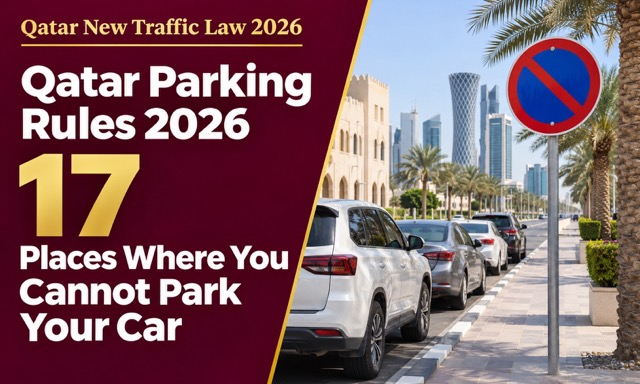
Qatar's new Traffic Law No. 19 of 2026 identifies 17 locations and situations where drivers are prohibited from parking or waiting in their vehicles. The restrictions, outlined in Article 85, cover everyday locations such as pedestrian crossings, residential entrances, roundabouts, bicycle lanes and spaces reserved for people with disabilities. Motorists who violate these provisions may face legal penalties, while vehicles parked illegally can be wheel-clamped or towed under the conditions established by law.
The legislation, issued on 4 November 2026, also introduces provisions concerning unattended vehicles, road obstructions and the removal of vehicles that interfere with traffic. For drivers in Doha and other parts of Qatar, understanding these rules is important because even a brief stop in a restricted location can create an obstruction or breach the law. Here are the 17 parking restrictions every motorist should know.
17 Places Where Parking Is Prohibited Under Article 85
1. Pedestrian Crossings and Pavements
Drivers are prohibited from parking or waiting on pedestrian crossings and pavements.
These areas are intended for pedestrians, and vehicles parked there can obstruct people crossing the road or walking along a pavement.
What drivers should know: Do not park on a pavement or pedestrian crossing, even if you intend to leave the vehicle there only briefly.
2. Bridges, Flyovers and Tunnels
Parking and waiting are prohibited on bridges, elevated road passages and inside tunnels, except where an emergency or necessity requires it.
The law also recognises designated areas reserved for military vehicles and ambulances.
What drivers should know: Do not stop on these structures for ordinary parking or waiting. The exception for necessity should not be treated as permission for routine stops.
3. Roads Near Hills and Sharp Bends
The law prohibits parking on the carriageway near hills, elevated road sections and bends.
Vehicles stopped in such locations may be difficult for approaching drivers to see, particularly where road visibility is limited.
What drivers should know: Avoid leaving your vehicle on the road near a hill or bend where it could interfere with approaching traffic.
4. Within 15 Metres of Junctions, Roundabouts and Pedestrian Crossings
One of the most important restrictions concerns parking near places where vehicles and pedestrians interact.
Under Article 85, drivers must not park within 15 metres of:
- Road junctions: Intersections where roads meet.
- Roundabouts: Entrances to roundabouts and public squares.
- Pedestrian crossings: Designated places for people to cross roads.
- Public transport stops: Stops used by public passenger transport vehicles.
What drivers should know: The restriction applies to distances of less than 15 metres. Drivers should leave sufficient clearance around these locations.
5. Road Sections With Continuous Lines That Cannot Be Crossed
Parking is prohibited on the carriageway beside long, continuous road markings that vehicles are not permitted to cross.
Such road markings regulate vehicle movements and separate areas where crossing is restricted.
What drivers should know: Do not use the roadside next to a continuous no-crossing line as a parking space.
6. Places Where Parked Vehicles Block Traffic Signals or Road Signs
Drivers must not park or wait where their vehicles could obstruct the visibility of traffic lights, road signs or other road users.
A vehicle left in the wrong position can prevent approaching motorists or pedestrians from seeing important road information.
What drivers should know: Before parking, ensure your vehicle does not conceal a traffic signal, road sign or another road user's view.
7. Entrances to Homes, Garages, Fuel Stations, Hospitals and Schools
Article 85 prohibits parking without permission in front of entrances and exits serving several important locations.
These include other people's homes, garages, petrol stations, vehicle energy-charging stations, hospitals, ambulance and firefighting centres, military facilities and educational institutions.
What drivers should know: Do not block these entrances or exits without permission, even when the vehicle is left there for a short period.
8. Places Where Another Parked Vehicle Cannot Move
Parking is prohibited where the position of one vehicle prevents another parked vehicle from moving.
This applies even if the obstructing vehicle is not parked directly across a marked entrance or exit.
What drivers should know: Before leaving your vehicle, check that other drivers can move their vehicles without being blocked.
9. Double Parking Beside Another Vehicle
The law prohibits stopping or waiting on the carriageway alongside another parked vehicle.
This is commonly known as double parking, where a driver leaves a car next to another vehicle rather than using an authorised parking space.
What drivers should know: Do not leave your car beside another parked vehicle on the road, even if you plan to return quickly.
10. Areas Where Parking or Waiting Is Not Authorised
Parking and waiting are prohibited in locations where they are not permitted.
This restriction covers places designated as no-parking or no-waiting areas under the applicable traffic rules.
What drivers should know: Follow parking signs, road markings and applicable restrictions. The absence of another vehicle does not automatically make a location suitable for parking.
11. Parking Spaces Reserved for People With Disabilities
Vehicles must not park or wait in spaces designated for persons with disabilities unless their use is authorised under the applicable rules.
These spaces are reserved to meet the needs of people who require accessible parking facilities.
What drivers should know: Do not use a designated accessible parking space unless you are entitled to park there.
12. Bicycle and Electric Scooter Lanes
Drivers are prohibited from parking or waiting in lanes designated for ordinary bicycles, electric scooters and similar vehicles.
These routes are intended to allow cyclists and scooter users to travel without obstruction from parked motor vehicles.
What drivers should know: Keep designated bicycle and electric scooter lanes clear, including when stopping temporarily.
13. Railway Tracks
Article 85 prohibits parking or waiting on railway tracks.
Vehicles left on railway infrastructure can interfere with transport operations and create dangerous obstructions.
What drivers should know: Never treat a railway track or rail corridor as a parking area.
14. Tram Tracks and Areas That Obstruct Tram Movement
Parking is prohibited on tram tracks.
The law also restricts parking beside tram tracks when the vehicle obstructs tram movement or forces other drivers to obstruct the tram.
What drivers should know: Keep tram routes clear, including adjacent areas where parked vehicles could interfere with tram operations.
15. Parking Against the Direction of Traffic
Drivers are not permitted to park or wait against the direction of traffic.
Parking in the opposite direction can create problems for vehicles travelling along the road and may require unsafe manoeuvres when entering or leaving a parking position.
What drivers should know: Ensure your vehicle is parked in the permitted direction of traffic.
16. Fire Hydrants and Electricity Generator Stations
Parking and waiting are prohibited at locations containing fire hydrants and electricity generator stations.
Access to such installations may be necessary for emergency response, maintenance or other operational purposes.
What drivers should know: Keep these locations unobstructed rather than using the surrounding space for parking.
17. The Left Side of a One-Way Road
The final restriction listed in Article 85 concerns parking on the left side of a one-way road.
Under the law, parking or waiting on the left side of a one-way road is prohibited.
What drivers should know: Do not assume that both sides of a one-way road are available for parking. Follow the applicable legal restrictions and designated parking arrangements.
Other Parking Rules Drivers Should Understand
Vehicles Must Be Parked in Authorised Locations
Article 84 requires vehicles to be parked or left waiting in designated places, in accordance with arrangements determined by the competent administrative unit at the Ministry of Municipality.
Article 86 separately regulates the parking of specified transport vehicles, including trucks, tractors, trailers and semi-trailers. The relevant vehicle categories and authorised parking locations are determined through ministerial decisions in coordination with the competent municipal authority.
Under Article 87, drivers are also prohibited from obstructing the use of metered parking spaces or causing congestion in front of them.
Do Not Leave Your Vehicle Running or With the Ignition Key Inside
Article 88 sets out additional responsibilities for drivers who leave their vehicles on the road.
Drivers must take the necessary precautions to prevent accidents, avoid obstructing traffic and protect the vehicle against unauthorised use.
The article also prohibits leaving a vehicle with its ignition key inside or leaving it running while unattended, even if the key has been removed.
Vehicles Obstructing Traffic Can Be Removed
Under Article 89, a vehicle must not be left on a road in circumstances where it could obstruct traffic or endanger other road users.
If the person responsible fails to move the vehicle within a reasonable period, the licensing authority may arrange its removal.
The vehicle owner is responsible for the removal costs. The law also states that the authority does not bear responsibility for damage that may occur to the vehicle during its removal under this provision.
What Happens If You Park Illegally in Qatar?
Qatar's new traffic legislation provides for legal penalties and enforcement measures against parking violations.
Under Article 111, violations of Article 85 fall within a category of offences punishable by imprisonment for up to one year, a fine of up to QAR 10,000, or either penalty.
These are the statutory maximum penalties for the relevant category of offences. They do not mean that every illegal parking incident automatically results in imprisonment or a QAR 10,000 fine. The legislation also contains provisions for settling specified traffic violations.
Wheel Clamping and Towing Rules
Article 100 permits authorities to wheel-clamp, remove or tow vehicles involved in specified parking and obstruction violations, subject to the conditions established by law.
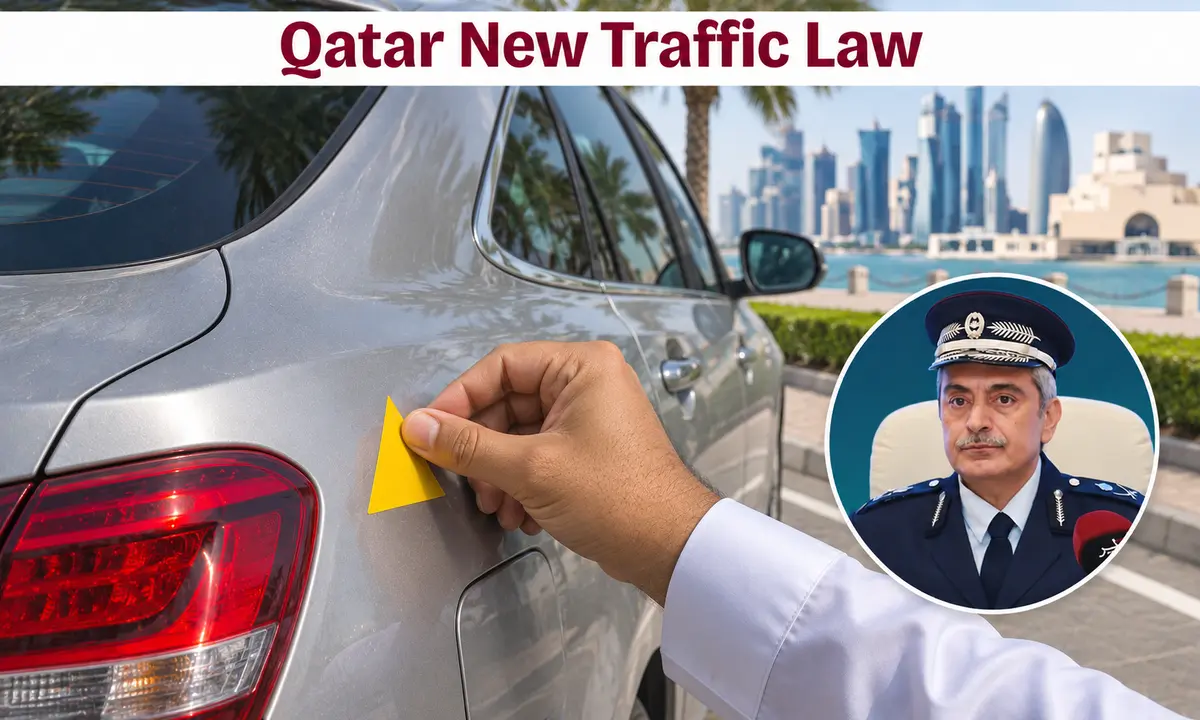
Where a wheel clamp is applied, a notice must be attached to the vehicle requiring the offender to contact the licensing authority within 24 hours of the notice to arrange its removal. If the required contact is not made within that period, the vehicle may be transferred to a designated impoundment location.
The article also provides that a vehicle must not be clamped or towed if the offender arrives before the clamp is fitted or the vehicle is loaded onto the recovery truck. In that situation, the statutory settlement or enforcement procedure applies.
Drivers should understand that illegally parked vehicles may face action beyond an ordinary parking violation, particularly when they block other motorists, pedestrians or authorised road users.
Quick Parking Safety Tips for Drivers in Qatar
Before leaving your vehicle, check whether parking is authorised and whether you are near a pedestrian crossing, roundabout or public transport stop.
Make sure your vehicle does not obstruct another car, block a building entrance, occupy a bicycle lane or restrict access to emergency facilities.
Drivers should also avoid leaving vehicles running while unattended and follow any parking signs or instructions issued by the relevant authorities.
Final Takeaway
Qatar's Traffic Law No. 19 of 2026 makes clear that parking restrictions are not limited to areas displaying a no-parking sign. Article 85 identifies 17 specific locations and situations where parking or waiting is prohibited, including pavements, junctions, residential entrances, double-parking locations, bicycle lanes and the left side of one-way roads.
The legislation also provides for fines, possible criminal penalties, wheel clamping and vehicle removal under the applicable legal conditions. Drivers can reduce the risk of violations by using authorised parking spaces and checking that their vehicles do not obstruct roads, entrances or other road users.
Legal Reference: Qatar Traffic Law No. 19 of 2026, particularly Articles 84–90, 100, 101 and 111, published in Qatar's Official Gazette, Issue No. 22 of 2026.
Disclaimer: This article is an informational guide based on the official Arabic text of Qatar Traffic Law No. 19 of 2026. It does not replace the legislation, applicable regulations or official instructions. Drivers should refer to the competent authorities for specific enforcement procedures and any subsequent regulatory updates.






.webp?w=1920&q=100)