


 Photo: SPA
Saudi Arabia’s agricultural production more than doubled over the past decade, rising from 6 million tons in 2015 to over 13 million tons in 2025, supported by significant government financing and private-sector investment. Deputy Minister of Environment, Water and Agriculture Mansour Al-Mushaiti said investment in the sector had exceeded SR60 billion, contributing to stronger food security and economic growth.
Speaking at the Budget 2027 Forum in Riyadh on Wednesday, November 25, Al-Mushaiti outlined the Kingdom’s progress in agricultural development, water conservation and environmental protection. He said the agricultural sector had become an increasingly important contributor to the national economy, with its contribution to gross domestic product (GDP) increasing from SR54 billion in 2015 to SR124 billion in 2025.
Over the past 10 years, the Agricultural Development Fund has provided more than SR40 billion in loans to support agricultural activities and investment. According to Al-Mushaiti, this amount is equivalent to the total financing provided by the fund during the preceding 50 years.
The deputy minister said the expansion of agricultural financing had encouraged greater private-sector participation, helping attract investments exceeding SR60 billion. These funds supported increased production and the development of agricultural activities across the Kingdom.
The rise in agricultural output from 6 million tons to more than 13 million tons represents an increase of over 116 percent between 2015 and 2025. During the same period, the sector’s GDP contribution also more than doubled, reaching SR124 billion.
Al-Mushaiti described agriculture as a central pillar of Saudi Arabia’s food security strategy and an important driver of economic and social development. He said the sector’s achievements reflected the impact of government policies and investment programmes introduced under Saudi Vision 2030.
The deputy minister emphasised that the Kingdom was beginning to realise the benefits of a decade of economic and structural reforms. He said development programmes were increasingly being evaluated according to their measurable results and their contribution to improving people’s lives.
Government investment and partnerships with private businesses have played an important role in strengthening food security, water management and environmental sustainability, according to Al-Mushaiti. These efforts are intended to improve the use of natural resources while supporting long-term economic development.
He also highlighted the Sustainable Agricultural Rural Development Program, known as Saudi Reef, as an example of government assistance generating measurable economic and social benefits in rural communities.
Over seven years, the government invested SR3 billion in the programme, which Al-Mushaiti said generated economic returns of SR10.7 billion. The initiative also created more than 92,000 income-generating opportunities and contributed to an increase of over 480,000 tons in rural production.
The programme focuses on supporting agricultural and rural activities according to the economic and environmental characteristics of different regions. Al-Mushaiti said this approach had helped increase local production while expanding income opportunities in rural areas.
Alongside the expansion of agricultural output, Saudi Arabia has introduced measures to reduce pressure on natural water resources. The deputy minister said the Kingdom had adopted a development approach that combines stronger agricultural productivity with more efficient water consumption.
As a result, consumption of non-renewable groundwater has declined by more than 40 percent, falling from 21 billion cubic metres to less than 11 billion cubic metres. Al-Mushaiti presented the reduction as an important achievement in the Kingdom’s efforts to balance food production with water security.
Environmental protection has also become a major component of Saudi Arabia’s development strategy, with national programmes focusing on land rehabilitation, tree planting and the expansion of protected areas.
Under the Saudi Green Initiative, the proportion of protected land has increased from 4 percent of the Kingdom’s total area in 2015 to more than 18 percent. Saudi Arabia aims to expand protected areas to 30 percent by 2030.
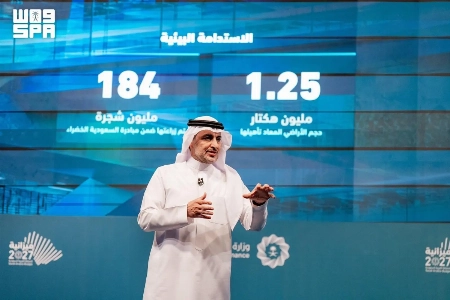
The initiative has also contributed to the rehabilitation of approximately 1.25 million hectares of land and the planting of 184 million trees, according to figures presented by Al-Mushaiti.
The deputy minister said these achievements reflected the Kingdom’s commitment to addressing environmental challenges while ensuring that natural resources remain available for future generations.
Saudi Arabia has also expanded its environmental cooperation beyond its borders through the Middle East Green Initiative, which has attracted participation from more than 35 countries.
At the international level, Al-Mushaiti highlighted the launch of the Global Coral Reef Research and Development Accelerator Platform during the G20 Summit in 2020. The initiative was introduced to support research and innovation related to protecting coral reef ecosystems.
He also referred to the Riyadh Global Drought Resilience Partnership, launched during the 2024 Conference of the Parties to the United Nations Convention to Combat Desertification. The partnership forms part of broader international efforts to address drought risks and strengthen environmental resilience.
Al-Mushaiti said the progress achieved across agriculture, water management and environmental sustainability had resulted from government support, the contributions of Saudi professionals and cooperation between public institutions, private businesses and society.
He emphasised that these partnerships would remain important as the Kingdom continues implementing its development priorities, strengthening food and water security, and pursuing environmental sustainability targets under Saudi Vision 2030.
Source: saudigazette

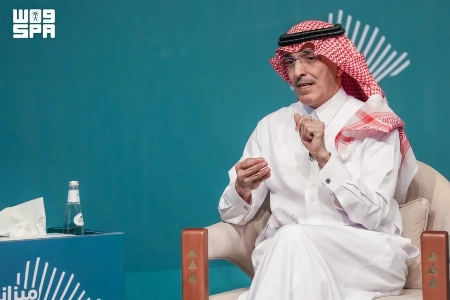 Photo: SPA